Convenience
The system removes friction. The user feels less burdened, and the work appears to move with less effort.
Signals
As software begins to prepare and carry out work, the question is not only what it can do, but who can authorize, limit and stop it.
A capable tool no longer only waits for instruction. It summarizes a document, prepares a reply, routes a task, or suggests an approval before the user has checked every piece of evidence.
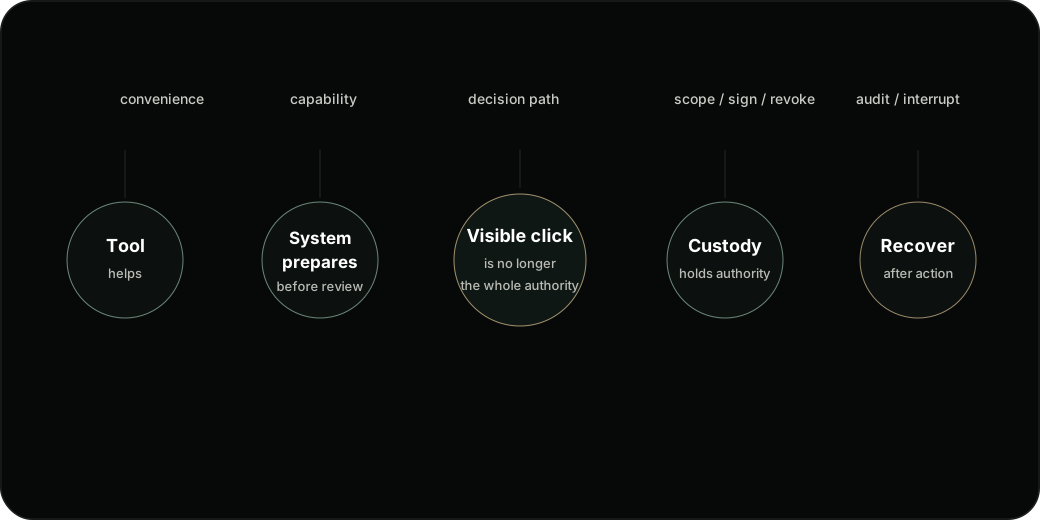
The visible click is still there, but it is no longer the whole moment of authority. Part of the decision path has moved into the system: what it noticed, what it ignored, what it prepared, and why it considered the action reasonable.
Here, custody means retaining control of an action: who may authorize it, what its limits are, and how it can be stopped or corrected. As software acts beyond the visible click, that control needs to travel with the work.
The useful future system may not be the one that does the most. It may be the one that keeps intent, evidence, permission, and recovery close enough for a person or organization to inspect.
Authority and recovery
This signal follows a practical shift: tools that once waited for visible instruction now prepare actions, move evidence, and suggest decisions before the user has inspected the full path.
Document signal
Some documents need to behave less like loose files and more like reviewed releases: source-aware, versioned, bounded, and clear about what has been included, reviewed, or protected.
Generated surface
Interfaces can become more adaptive without becoming the place where authority lives. A generated surface may suggest a path, but action still needs validation, stable rendering, and explicit permission.
Ecosystem signal
A technical ecosystem can look impressive before its proof path is mature. The stronger signal is restraint: grow the ecosystem only as fast as coordination, evidence, and maturity claims can remain visible.
Pattern in motion
The system removes friction. The user feels less burdened, and the work appears to move with less effort.
Reasoning moves behind the surface. The user remains present, but less able to locate the decision.
The important question becomes who can authorize, pause, narrow, inspect, and recover the action.
5G, satellite networks, and edge systems are not only faster channels. They change what can be observed, coordinated, and acted upon in real time.
Personalized systems should recognize enough context to be useful without turning every visitor, worker, or device into an exposed profile.
The serious shift is not a new front end. It is whether evidence, decisions, handoffs, and accountability become easier to see.
Next