Software and connected systems, developed around the practical questions of everyday work.
01 / EOS
Keeping work connected
Earlier software design
A request starts in one place. Its supporting document is elsewhere. By the time a decision is needed, someone has to reconstruct what changed and which version is ready for review.
EOS was conceived as a daily operating platform bringing entries, documents, approvals, finance, people operations, and reporting into a common working environment. The aim was to keep the record close to the work it described.
A record through review
Consider a purchase request. Its description, supporting document, and review decision each answer a different question. Reading them together makes it possible to ask not just whether a decision exists, but which information it was based on.
That relationship matters when the work changes hands. The next person needs the reasoning as well as the result.
Illustrative work record
Purchase request
A request, its supporting information, and a decision kept together.
01
Request
What is needed?
02
Supporting document
What informs the decision?
03
Review
What was decided, and why?
Context travels with the record.
Illustrative record, not an EOS screenshot or customer workflow.
02 / Telemetry Gateway
Reading a changing system
Earlier R&D direction
A reading changes at a device. From a distance, that number says little on its own. Is the equipment working harder, has its environment changed, or does someone need to investigate?
The Telemetry Gateway direction concerned collecting information from physical systems. The question behind it remains useful: how can a signal become something an operator can interpret and act on?
From a reading to a useful question
A temperature reading needs a time, a source, and a comparison. A rising value can mean something different during startup than during steady operation. An operating view should preserve that distinction instead of presenting every change as an alarm.
This is the difference between collecting more information and making a condition easier to understand.
An illustrative sequence
Measurement
A reading changes
Something has changed at the device.
Interpretation
The condition gains context
Time and operating state help explain it.
Response
A person can investigate
The next question becomes more specific.
Conceptual sequence. No live measurements or deployed gateway are shown.
03 / Manufacturing traceability
Following the life of a component
Earlier R&D direction
A finished component carries the result of many small decisions. When a question appears later, its inspection record may matter just as much as the component itself.
Process digitalization and manufacturing traceability formed another direction in ELM's earlier work. At its centre is a practical relationship: keeping an item connected to the steps and records that explain its condition.
When a record needs to be found again
An inspection result becomes more useful when it can be related to the right item and stage of work. Without that connection, the record may exist while the question remains unanswered.
The aim is not to document every movement. It is to preserve enough context for a later person to understand what happened and decide what to check next.
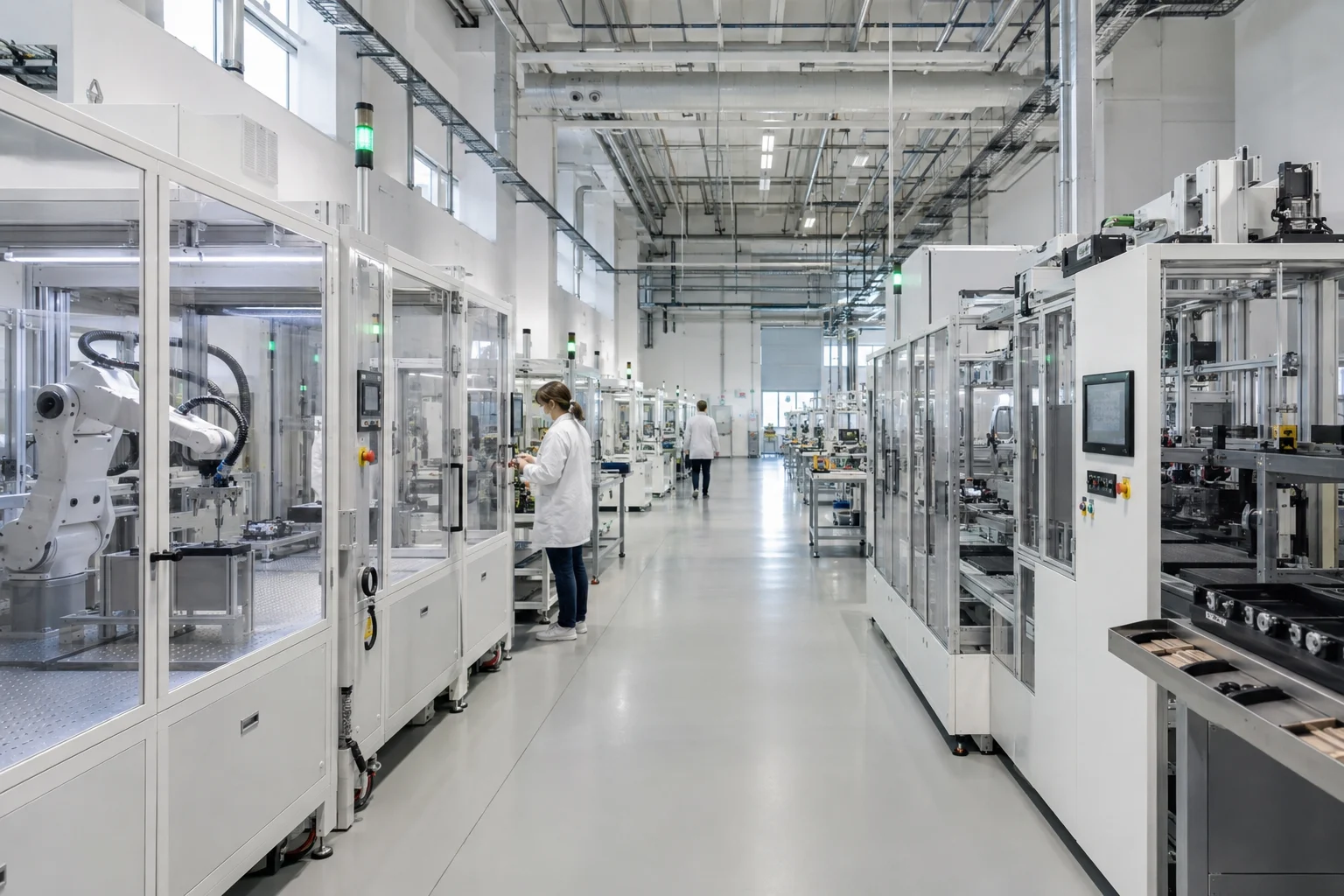
AI-generated manufacturing illustration, not an ELM deployment or customer site.